AI Budgeting Apps in Canada: What AI Should Actually Do With Your Money
"AI budgeting app" can mean almost anything right now — from a chatbot repeating generic tips to software that actually reads your transactions. Here's how to tell the difference, and what an AI money app in Canada should really do for you.
On this page
Search "AI budgeting app Canada" today and you get a strange mix: a few fintech pages, some app-store listings, and a lot of articles explaining that "AI is changing personal finance" without ever saying how. The label has been stretched so far that it's nearly meaningless. An app can slap "AI" on the box for writing a tip in a friendly tone — or for genuinely reading your bank transactions and telling you what changed.
That gap matters, because the two are not remotely the same product. This guide breaks down the five things "AI" can actually refer to in a money app, ranked from least to most useful, so you can tell a real AI personal finance app in Canada from a chatbot wearing a budgeting costume.
Why "AI budgeting app" has become a fuzzy label
"AI" sells, so it gets attached to almost everything. The problem for Canadians shopping for an AI money management app is that the word covers two very different things at once:
- AI as a writer — software that generates text. It can phrase advice nicely, but the advice itself may be generic and have nothing to do with your money.
- AI as an analyst — software that processes your real financial data, finds patterns, and surfaces what's relevant to you specifically.
Most "AI is the future of finance" articles never make this distinction, which is exactly why they feel hollow. The useful question isn't "does it use AI?" — almost everything claims to now. It's "what does the AI actually do with my transactions?"
The five things "AI" can mean in a money app
Here's the spectrum, from the kind of AI that's basically decoration to the kind that's actually doing the work.
1. AI-generated text wrapped around generic advice
This is the shallow end. The app uses a language model to produce friendly-sounding paragraphs — "Try the 50/30/20 rule!", "Consider cutting back on dining out!" — that would apply to literally anyone. It reads like a finance blog written on demand.
There's nothing wrong with good general advice, but this isn't personalization. The model never looked at your spending; it just wrote text. If an app's "AI insights" never reference an actual number, category, or change from your accounts, this is probably what you're getting.
2. AI categorization
A real, useful first job for AI: sorting your transactions into categories automatically. "TIM HORTONS #4021" becomes Dining, "PRESTO/TRANSIT" becomes Transport, a recurring charge becomes a Subscription — with no rules to set up and no manual tagging.
This is the layer that quietly kills most budgeting habits when it's missing, because manual categorizing is the upkeep nobody sustains. Good automatic spending analysis starts here: if the categories aren't reliable, nothing built on top of them can be either.
3. Pattern and anomaly detection
Once transactions are categorized, AI can watch them over time and flag what's unusual. This is where an AI spending tracker in Canada starts earning its name. Instead of just showing you a category total, it notices:
- A category that's trending up month over month.
- A subscription that renewed at a higher price.
- A duplicate charge, or a one-off that's well outside your normal range.
- A week where spending spiked compared to your own baseline.
The key word is your. Anomaly detection is only meaningful when it's measured against your personal history — not a generic benchmark.
4. Forecast interpretation
Detecting the past is useful; projecting forward is where it gets genuinely helpful. An AI cash flow forecast in Canada looks at your recurring income, fixed bills, and spending pace, then estimates where you'll land — for example, "at this rate you'll finish the month about $140 tighter than last month."
But a forecast number on its own is still just a number. The valuable part is interpretation: AI explaining what's driving the projection and what you could do about it, in a sentence, rather than handing you another line on a chart to decode.
5. Personalized insights grounded in real transaction data
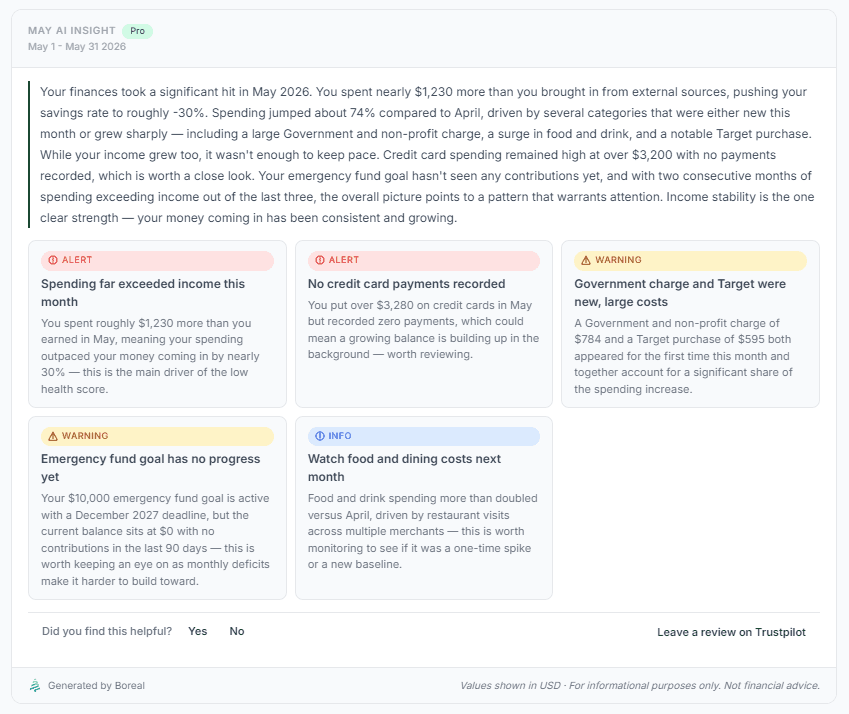
This is the top of the spectrum and the whole point of an AI financial insights app. It combines the layers below it: clean categorization, pattern and anomaly detection, and forecasting — then uses a language model only at the last step, to explain the finding in plain language.
The difference from level 1 is everything. Here the AI doesn't invent advice; it reports something true about your accounts:
"Your dining spend is up 22% this month, mostly from weekend delivery — about $90 above your usual."
That sentence is only possible because real AI analyzed your bank transactions first, then wrote the explanation second. Level 1 writes first and analyzes never.
How to tell a real AI budgeting app from a chatbot
When you're evaluating an AI money management app for Canadians, the tell is whether the "intelligence" is anchored to your data. Quick checks:
- Does it cite your actual numbers? Real insights reference your categories, amounts, and changes. Generic ones don't.
- Does it react when your spending changes? If next month's "insight" is the same advice regardless of what you did, it isn't reading your transactions.
- Does categorization just work? Reliable automatic categorization is the foundation; if you're tagging everything by hand, the AI layer is thin.
- Does it explain forecasts, not just display them? Interpretation beats a raw projection.
- Is the data handling honest? AI that analyzes bank transactions should do so over a secure, read-only connection — and never sell your data.
How Boreal approaches AI
Boreal is built from the top of that spectrum down. It connects to your Canadian bank accounts securely through Plaid — read-only, so it can see your transactions but can never move money, and you log in through your bank's own portal so Boreal never sees your banking password.
From there it categorizes your spending automatically, watches your patterns for what's changed, and projects where your month is heading. AI comes in at the end to turn all of that into a plain-language insight you can actually act on — not generic advice, but something specific to your accounts, like a heads-up that one category crept up or that three subscriptions renewed this week. That's the difference between an app that talks about AI and one that uses it on your real money. See how Boreal works.
The bottom line
"AI budgeting app" isn't one thing — it's a spectrum from generated text to genuine analysis. The apps worth your time in Canada are the ones where AI does the unglamorous work first: categorizing transactions, spotting patterns, forecasting your month, and only then explaining it in a sentence. If an app's AI never references a real number from your own accounts, it's writing, not analyzing. The whole promise of an AI personal finance app in Canada is to turn your real transactions into a decision — and that only works when the intelligence is grounded in your data, not in advice that would fit anyone.
Frequently asked questions
What is an AI budgeting app?
An AI budgeting app uses artificial intelligence to help you understand and manage your spending. In practice the term covers a wide range — from apps that just generate generic written tips, to apps that automatically categorize your transactions, detect spending patterns, forecast your cash flow, and produce personalized insights based on your real bank data. The useful versions analyze your actual transactions rather than only writing general advice.
What should an AI budgeting app actually do with my money?
A genuinely useful AI budgeting app in Canada should categorize your transactions automatically, detect patterns and anomalies against your own history, forecast where your month is heading, and explain all of that in plain language. The "AI" should be grounded in your real spending data — if its insights never reference your actual numbers, categories, or changes, it's generating text rather than analyzing your money.
What's the difference between AI categorization and AI insights?
AI categorization is the foundational step — sorting each transaction into a category like dining, groceries, or transport automatically, with no manual tagging. AI insights are built on top of that: once spending is categorized, the app detects patterns, compares against your history, and surfaces what's worth knowing as a plain-language sentence, such as "dining is up 22% this month." Categorization is the input; insights are the payoff.
Can an AI app analyze my bank transactions safely in Canada?
Yes, when it uses a secure, read-only connection through a provider like Plaid. A read-only connection lets the app see your transactions to analyze them, but it cannot move money or make payments, and you log in through your bank's own portal so the app never sees your banking password. Boreal, for example, connects read-only, never stores your credentials, and never sells your data.
Does an AI budgeting app give a real cash flow forecast?
The better ones do. An AI cash flow forecast in Canada estimates where you'll end the month based on your recurring income, fixed bills, and spending pace — and the most useful apps also interpret that projection, explaining what's driving it rather than just showing a number. Boreal forecasts your month and explains the result in plain language so you can act on it.
Is an AI budgeting app better than a spreadsheet?
For most people, yes — mainly because it removes the upkeep that kills spreadsheets. A spreadsheet depends on you exporting, re-typing, and categorizing every transaction by hand each month, whereas an AI app syncs and categorizes automatically and tells you what changed. A spreadsheet gives you data; a good AI budgeting app gives you an interpretation you can act on.
Tags
Take control of your money
Boreal turns your accounts into clear, AI-powered insights. Join the early access.
Related posts
How Automatic Transaction Categorization Works — and Why Transfers Get Counted Wrong
Every app that connects to your bank promises to sort your spending for you. Most of them get the ordinary purchases right and then quietly ruin your totals with transfers, credit card payments, refunds, and savings contributions. Here's how automatic categorization actually works, exactly where it breaks, and how to tell whether your numbers can be trusted.
How to Predict Your Bank Balance at the End of the Month
Your balance today doesn't tell you whether you'll make it to payday. Here's how to predict your bank balance at the end of the month using the bills, income and everyday spending you already have — including a simple worked example, and how an app can project your cash and warn you before you dip.
How to Track Your Spending Without Making a Budget
Not everyone wants to build a budget — and you don't have to. If your goal is to understand where your money goes and avoid surprises, here's how to track spending without budgeting: no categories to set up, no transactions to sort, no spreadsheet to babysit.