How to Predict Your Bank Balance at the End of the Month
Your balance today doesn't tell you whether you'll make it to payday. Here's how to predict your bank balance at the end of the month using the bills, income and everyday spending you already have — including a simple worked example, and how an app can project your cash and warn you before you dip.
On this page
Your bank balance right now is a snapshot, not a forecast. It tells you what you have today — not whether rent, your car insurance, three subscriptions and next week's groceries will leave you comfortable or scraping by on the 29th. That gap between "what I have now" and "what I'll have left" is where most money stress actually lives.
The good news: you don't need to be an accountant to close it. If you know roughly what's still coming in, what's going out, and how you tend to spend, you can predict your bank balance at the end of the month with a single line of arithmetic. This guide walks through that math in plain language, gives you a worked example, and shows how an app can keep the inputs current for you automatically — including the part most people care about most, whether you'll dip before your next paycheque.
Why your current balance can't tell you if you're okay
A balance is a single moment in time. Two people can both have $3,400 in their chequing account today and be in completely different situations:
- One has already paid rent and has no big bills left this month.
- The other has rent, a credit-card payment, and an annual insurance charge all landing before payday.
Same number, opposite reality. This is why "just checking your balance" feels reassuring right up until a scheduled payment clears and you're suddenly overdrawn. What you actually want is a future bank balance calculator — a way to see where the number is heading, not just where it sits.
That's the shift from tracking to forecasting: instead of looking backward at what you spent, you look forward at what's still to come.
The simple formula to predict your month-end balance
At its core, a monthly cash flow forecast for personal finance is one equation:
Current balance + remaining income − expected bills and spending = projected month-end balance
Three inputs, one answer. Let's break down each one:
- Current balance — what's in your everyday spending account right now.
- Remaining income — any pay, benefits or transfers you still expect to receive before month-end.
- Expected bills and spending — everything still going out: fixed bills (rent, loan payments, insurance), recurring charges (subscriptions, memberships), and your normal everyday spending (groceries, gas, coffee) for the rest of the month.
The first two are usually easy. The third is where people get it wrong — not because the bills are hard to list, but because they forget the everyday spending that quietly adds up between the big bills.
A worked example: forecasting a real month
Say it's the 12th of the month. Here's how to forecast upcoming expenses and land on a projected balance:
- Current balance: $3,400
- Remaining income (one more paycheque before month-end): $2,700
- Expected bills and recurring spending (rent, insurance, subscriptions, plus estimated groceries, gas and everyday spending for the rest of the month): $4,900
Now run the formula:
$3,400 + $2,700 − $4,900 = $1,200
Your projected month-end balance is $1,200. That's a very different feeling than the $3,400 you saw when you opened your banking app this morning. It's still positive — you're fine — but now you *know* you're fine, and you know you have about $1,200 of genuine breathing room, not $3,400.
Flip one number and the story changes. If that remaining income were $1,700 instead of $2,700, your projected balance drops to $200 — close enough to zero that you'd want to hold off on any non-essential spending. That's the whole value of forecasting: you find out on the 12th, while you can still do something about it, instead of on the 30th when it's too late.
Why doing this by hand is hard to keep up
You can absolutely run this math in your head or a spreadsheet once. The problem is keeping it accurate as the month moves:
- Bills don't all land on the 1st. Insurance renews annually, subscriptions renew on odd dates, and it's easy to forget the ones that only charge every few months.
- Everyday spending is a moving target. Estimating "groceries and gas for the rest of the month" is guesswork, and your guess drifts as you actually spend.
- Recurring charges change quietly. A subscription creeps up $4, a new one appears, an old one you forgot about keeps charging. Each one bends your forecast.
A manual forecast is accurate the moment you build it and slowly wrong every day after. That's exactly the kind of repetitive, always-changing calculation software is good at — which is why an app that predicts future spending from your actual transactions beats a spreadsheet you have to babysit.
What to look for in a personal cash flow forecast app in Canada
If you'd rather see where my bank balance will be without doing the arithmetic yourself, look for a personal cash flow forecast app in Canada that does these things:
- Uses your real transactions, not manual entry. It should connect to your bank and pull income and spending automatically, so the forecast is based on what actually happens — not what you remembered to type in.
- Detects your recurring bills and subscriptions. The app should recognize rent, insurance, memberships and subscriptions on its own, so upcoming charges are already in the forecast without you listing them.
- Tells you when you'll dip, not just where you end. An ending balance can look fine while the balance passes through zero on the 22nd. The more useful tools show the projected *lowest* point in the window and flag it before you get there.
- Is honest about how far ahead it projects. A projection built from detected recurring bills is most reliable over the next couple of weeks; estimates of everyday, non-recurring spending are guesses no matter who makes them. Prefer a tool that tells you its horizon over one that implies it can predict any date precisely.
- Shows a plain-language answer. You want "your cash is projected to drop below your cushion on the 22nd," not a chart you have to interpret. Some apps frame a version of this as a "safe to spend" number.
- Connects securely and read-only. It should link through open banking in read-only mode — able to see transactions but never move money — and never sell your data.
That last point matters in Canada specifically: any trustworthy safe to spend app in Canada connects through a regulated open-banking provider and logs you in through your own bank, so it never sees your banking password.
How Boreal answers this in practice
Boreal was built around this exact question: not "what did I spend," but "where is my cash heading." You connect your Canadian bank accounts once through Plaid — read-only, so Boreal can see your transactions but can never move money, and you log in through your bank's own portal so Boreal never sees your banking password.
From there, Boreal answers the question in two pieces rather than pretending one number covers everything.
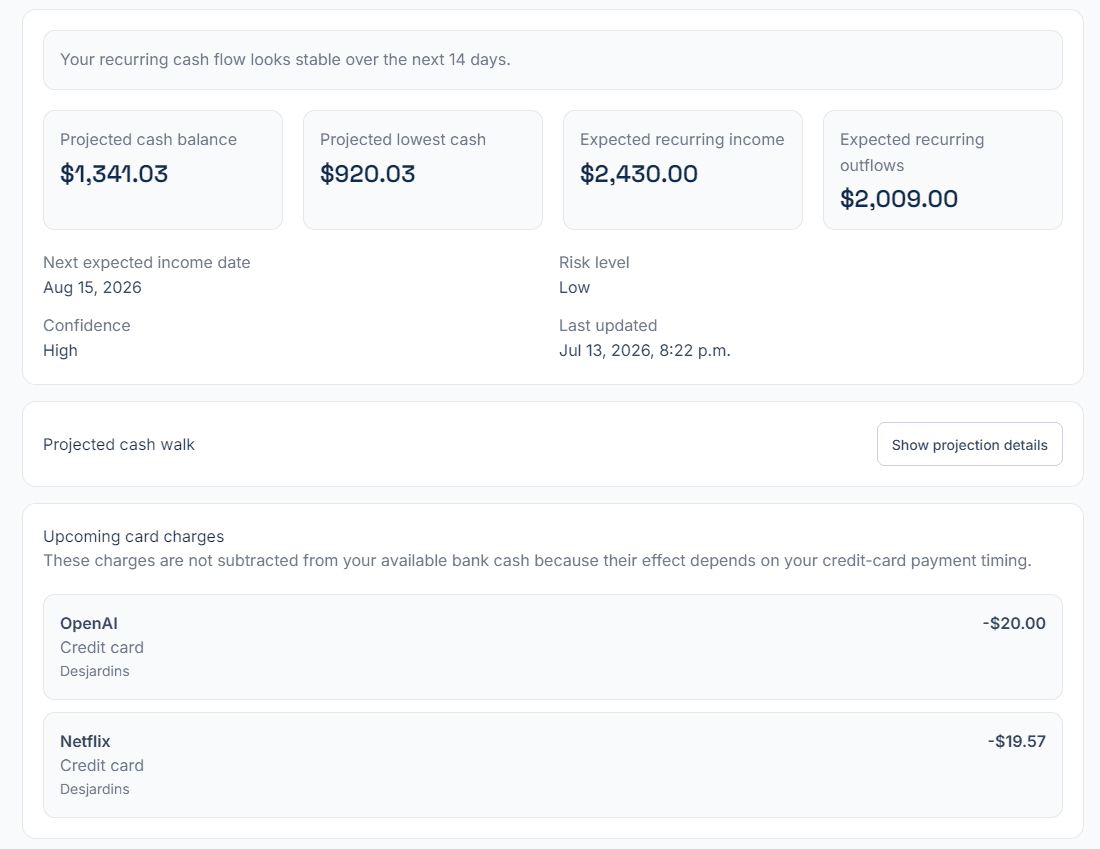
A cash-flow projection for the next 14 days. Boreal takes your current available cash, adds the recurring income it has detected, subtracts the recurring bills and subscriptions it has detected, and shows you the projected balance and the projected *lowest* point across that window — plus the date of your next expected income. You set a cash buffer, and Boreal flags when your projected cash is expected to drop below it, or below zero before your next paycheque arrives.
An income-and-expense forecast for the current month and the next three. Separately, Boreal projects your income, expenses and net by category and merchant across a four-month horizon, so you can see the shape of the month rather than a single day's balance.
Two honest limits, because they change how you should read the numbers. The 14-day projection is built from *recurring* activity — detected bills and income — so it does not attempt to estimate your everyday groceries-and-gas spending. And it projects two weeks ahead, not to an arbitrary calendar date. If today is the 3rd, that window reaches past month-end; if it's the 12th, it covers the stretch to your next paycheque rather than the 30th.
That's a deliberate trade. For most people the binding constraint isn't the 30th — it's whether they make it to the next paycheque without dipping, and that's a window where a projection built on real detected bills is genuinely reliable rather than a guess dressed up as a number. Because Boreal recognizes recurring charges on its own, upcoming bills are already in the projection, and when a subscription changes price or a new one appears, it's picked up instead of leaving your estimate quietly stale. See how Boreal works for the full picture.
Best for: People who want to know whether they'll dip before their next paycheque, and see the month's income and expenses taking shape — without building or maintaining the forecast by hand.
The bottom line
Predicting your bank balance at the end of the month isn't complicated math — it's *current balance + remaining income − upcoming bills and spending*. The hard part isn't the formula; it's keeping the inputs accurate as bills land on odd dates, everyday spending drifts, and subscriptions change underneath you. Run it once by hand to understand your month, then let an app that reads your real transactions keep the recurring inputs current — and tell you before you dip, which is usually the answer you were really after. If you'd rather skip budgeting entirely and just stay informed, here's how to track spending without making a budget, and if you're curious how automatic forecasting works, our guide to an AI budgeting app in Canada covers that too.
Frequently asked questions
How do I predict my bank balance at the end of the month?
Use one simple formula: current balance + remaining income − expected bills and spending = projected month-end balance. Start with what's in your account today, add any pay or transfers you still expect before month-end, then subtract everything still going out — fixed bills, recurring charges, and your normal everyday spending for the rest of the month. The result is your projected month-end balance. An app like Boreal keeps the recurring half of that math current automatically from your real transactions, projecting your available cash over the next 14 days and warning you when it's set to drop below your cash buffer.
What is a future bank balance calculator?
A future bank balance calculator projects where your balance will be at a future date — usually month-end — instead of just showing today's number. It combines your current balance, the income you still expect, and your upcoming bills and spending to estimate the balance you'll actually be left with. The most accurate versions pull from your real transactions rather than numbers you type in, so the forecast reflects what genuinely happens each month.
Is there an app that predicts future spending in Canada?
Yes. A personal cash flow forecast app in Canada connects to your bank through open banking, detects your recurring bills and subscriptions, and projects them forward to estimate where your cash is heading. Boreal does this in read-only mode — it can see your transactions to build the projection but can never move money, and it never sees your banking password because you log in through your own bank. Boreal projects your available cash 14 days ahead from detected recurring income and bills, and separately projects income and expenses for the current month plus the next three.
How is forecasting my balance different from budgeting?
Budgeting is planning your spending in advance and holding yourself to category limits. Forecasting is simply predicting where your balance will land based on what's actually coming in and going out — no limits to set, no categories to police. You can forecast without budgeting at all: it answers "will I be okay this month?" rather than "did I stay under my plan?" Many people find a forecast more useful day to day because it looks forward, not backward.
What is a "safe to spend" number?
Safe to spend is how much you can spend right now without putting your projected balance at risk. It's calculated by taking your projection and setting aside the bills, recurring charges and essential spending still to come, so what's left is genuinely discretionary. A safe to spend app in Canada keeps this number current as new transactions come in, so you know how much room you actually have rather than guessing from today's balance. Boreal approaches the same problem from the other direction: instead of publishing a single spendable figure, you set a cash buffer — the cushion you want to stay above — and Boreal warns you when your projected cash is expected to fall below it.
How far ahead can Boreal predict my balance?
Boreal projects your available cash 14 days ahead, and separately projects your income, expenses and net for the current month plus the next three. So the balance projection covers the next two weeks rather than a fixed calendar date: early in the month that window reaches past month-end, and mid-month it covers the stretch to your next paycheque. The 14-day projection is built from detected recurring income and bills, so it doesn't try to estimate everyday non-recurring spending like groceries or gas — which keeps it reliable for the question most people actually have, which is whether they'll dip before payday.
Do I need to enter all my bills manually to forecast my balance?
No — the best tools detect them for you. Rather than listing every bill and subscription by hand, an app that reads your transactions recognizes recurring charges automatically and includes them in the projection. That's what keeps a projection accurate over time: when a subscription changes price or a new recurring charge appears, it's picked up on its own instead of leaving your manual estimate quietly out of date. Boreal detects recurring streams this way so upcoming bills are already in your projection.
Tags
Take control of your money
Boreal turns your accounts into clear, AI-powered insights. Join the early access.
Related posts
How Automatic Transaction Categorization Works — and Why Transfers Get Counted Wrong
Every app that connects to your bank promises to sort your spending for you. Most of them get the ordinary purchases right and then quietly ruin your totals with transfers, credit card payments, refunds, and savings contributions. Here's how automatic categorization actually works, exactly where it breaks, and how to tell whether your numbers can be trusted.
How to Track Your Spending Without Making a Budget
Not everyone wants to build a budget — and you don't have to. If your goal is to understand where your money goes and avoid surprises, here's how to track spending without budgeting: no categories to set up, no transactions to sort, no spreadsheet to babysit.
AI Budgeting Apps in Canada: What AI Should Actually Do With Your Money
"AI budgeting app" can mean almost anything right now — from a chatbot repeating generic tips to software that actually reads your transactions. Here's how to tell the difference, and what an AI money app in Canada should really do for you.